Three hundred and fifty metres from the riad, a 14th-century Koranic school and a water clock whose workings nobody can now explain exactly.
The largest madrasa in Fez
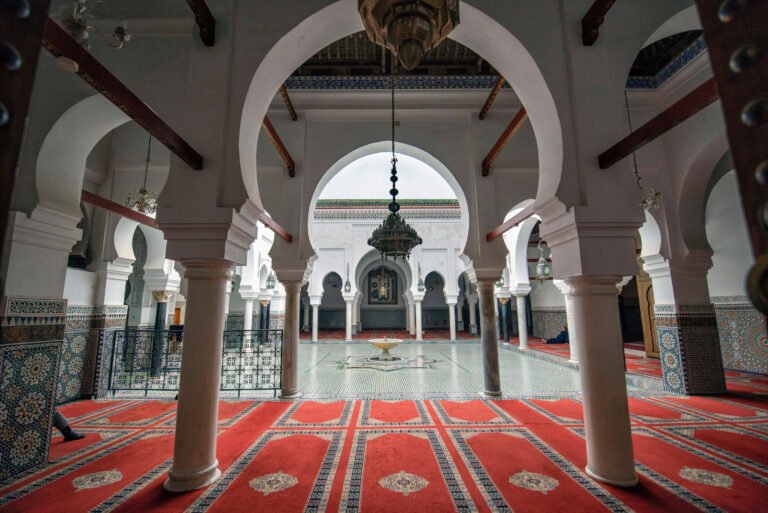
The Bou Inania Madrasa was founded between 1350 and 1355 by the Merinid sultan Abu Inan Faris. It is the largest of the madrasas of Fez and the only one with a minaret, which makes it a mosque in its own right. It can be visited, unlike the city’s great mosques.
What to look at in the courtyard
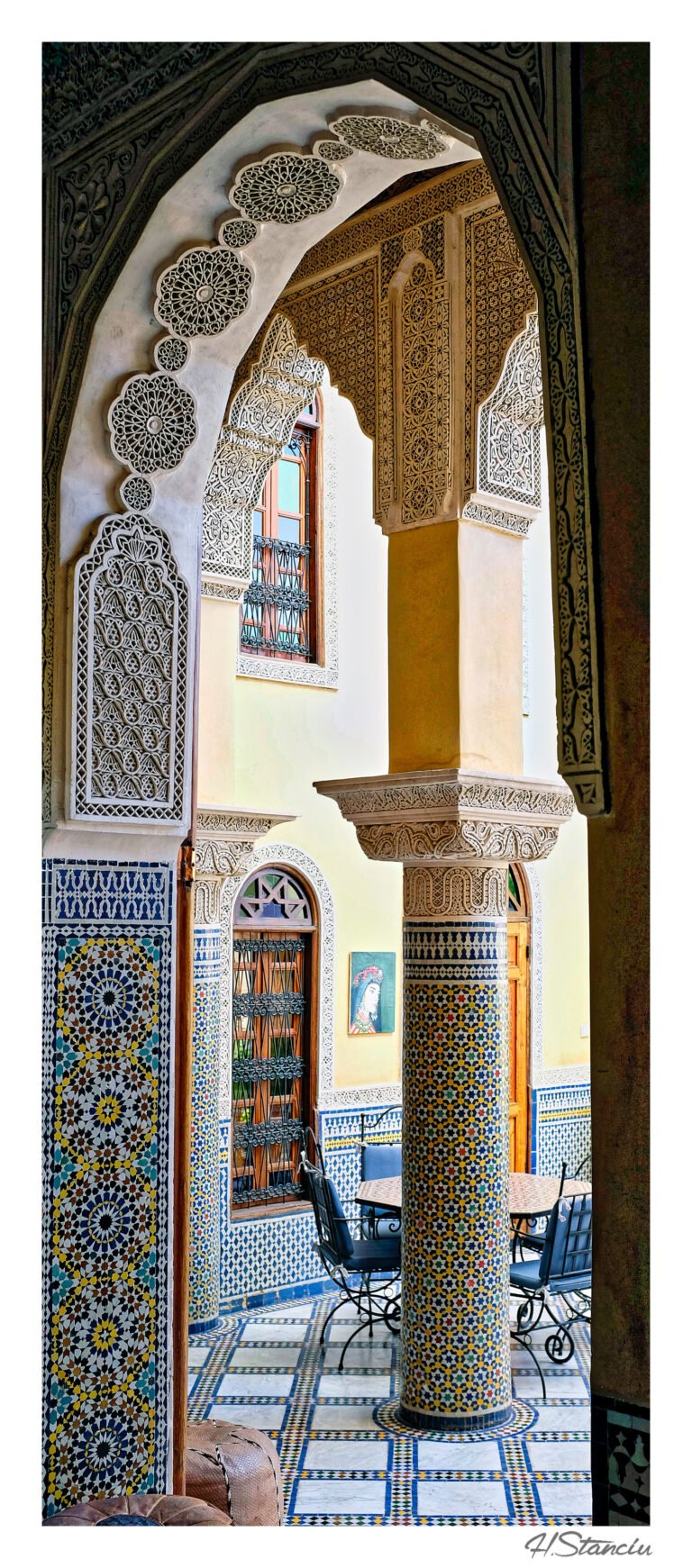
A floor of marble and zellige, walls of carved stucco up to three metres high, then cedar mashrabiya screens and friezes of Kufic inscriptions — the three registers described in our article on zellige, stucco and cedar. Students lodged in the cells on the upper floors and followed a programme of law, theology, grammar and rhetoric. The madrasa library held many rare manuscripts.
Thirteen brackets and a puzzle
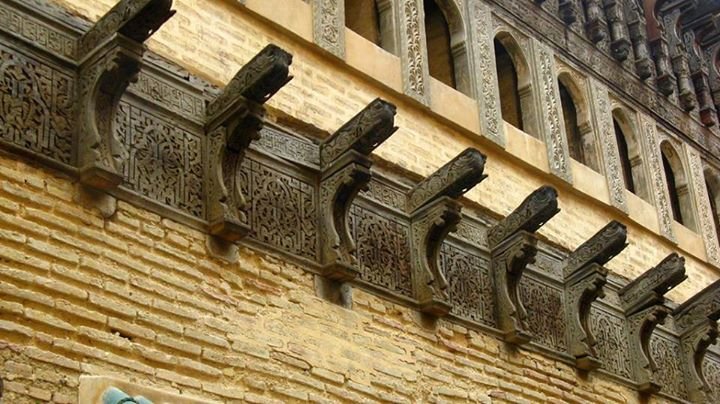
Almost opposite, on the Talaa Kebira, thirteen wooden brackets project from the wall above the shops, each originally holding a brass bowl. This is what remains of the hydraulic clock built in the 14th century and attributed to Abu Abdallah Muhammad al-Bouinani. A system of floats and counterweights dropped a ball into a bowl at set intervals, to announce the hours of prayer.
The mechanism has been stopped for centuries and exactly how it worked is still debated. It survives as a fragment: one of the few timekeeping devices of that period still visible in its original place, in the street, above the passers-by.
In practice
Allow thirty minutes for the madrasa, five for the clock. Both are on the way if you walk down the Talaa Kebira from the riad. For historical context, see our history of Fez and Fez, imperial city pages.